
Âm which means “sound,” “vibration,” or “inner resonance” in Vietnamese, invites audiences to discover what connects us beyond languages, territories, and histories.
A journey along invisible pathways, where music paves the way for unexpected encounters.
Bringing together the El Pieto Quartet, oud player Abdul-Wahab Kayyali, flamenco guitarist Caroline Planté, and đàn tranh duo Hanh Dung Ly and Phuong Anh Nguyen, this concert brings together a constellation of strings and voices whose musical traditions have been shaped by displacement, exile, and transmission.
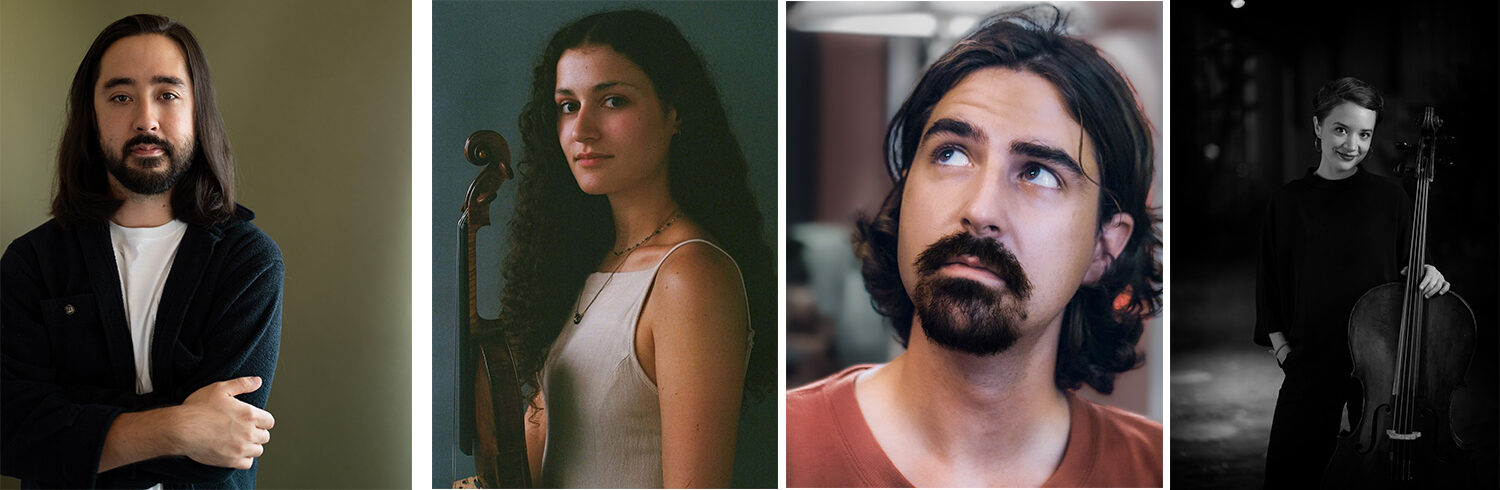
El Pieto Quartet
Vincent Kim, violin; Marie-Édith Racine, violin; Arthur Tanguay-Labrosse, viola; Eugénie Lalonde, cello
Founded in 2008 at École secondaire Joseph-François-Perreault, the El Pieto Quartet made its mark during its very first year by earning an exceptional score of 97% at the Victoriaville Chamber Music Competition. With a mission to introduce audiences to chamber music, the quartet went on to collaborate with various municipalities over the following decade, offering free concerts in parks and public gathering places. The quartet has performed in Montréal, Laval, Saint-Jérôme, Repentigny, and Crabtree.
The ensemble’s repertoire ranges from Baroque to contemporary music, but the El Pieto Quartet has also embraced other musical styles, including tango and even popular music. The quartet can, for example, be heard on the album Waltzed in from the Rumbling by Montréal-based band Plants and Animals, released in 2016.
Today, all four members of the quartet pursue careers beyond performing their instruments. Yet throughout all these years of playing together, and to this day, their love of chamber music and their desire to share it with others remain the foundation of El Pieto.
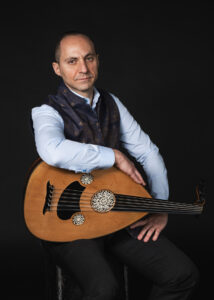
Abdul-Wahab Kayyali
Described as “a maestro in his own right” by BBC Music Magazine and as an “oud virtuoso” by CBC Music, Abdul-Wahab Kayyali studied the oud with Sakher Hattar at the National Music Conservatory in Amman, Jordan. During his time in Amman, he also received instruction and guidance from Iraqi oud virtuoso Munir Bashir.
He has performed as a soloist and as a member of ensembles around the world. In 2020, he co-founded the world music trio Les Arrivants in Montréal with Hamin Honari and Amichai Ben Shalev. He also released his first solo album, Juthoor, in 2020.
More recently, he has collaborated in performances and recordings with Naseem Alatrash (cello), Tariq Harb (classical guitar), Saeed Farajpouri (kamancheh), Salah Eddin Maraqa (qanun), Merrie Klazek (trumpet), Haitham Haidar (vocals), and the ensemble Constantinople.
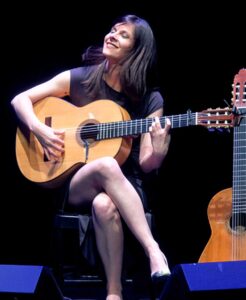
Caroline Planté
Caroline Planté began learning flamenco at the age of seven under the guidance of her father, flamenco guitarist Marcel “El Rubio” Planté, one of the pioneers of the genre in Québec during the 1960s.
In 2004, her meeting in Madrid with choreographer and dancer Mariano Cruceta marked a decisive turning point in her understanding of the art form. From 2004 to 2013, as members of the Cruceta Flamenco company, they created eight choreographic and musical works as well as a short film.
It was in Spain that she fully embraced the freedom to develop a more personal approach, moving away from the stereotypes traditionally associated with flamenco guitar.
After ten years of working professionally in Spain—punctuated by tours throughout Europe and the Americas—her desire to be closer to her family and continue her artistic journey in her hometown brought her back to Montréal in 2013.
Recognized for the distinctive and sensitive quality of her playing, she has also contributed as a collaborating guitarist to numerous album recordings. Her flamenco guitar sound, sought after for its depth and unique signature, has led her to collaborate with artists from a wide range of musical backgrounds.
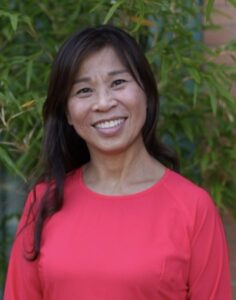
Hanh Dung Ly
Hanh Dung Ly is a đàn tranh musician and heir to a long family tradition devoted to Vietnamese traditional music.
She began studying the instrument at the age of five at the Saigon Conservatory under the guidance of her aunt, the great master Phuong Oanh. For more than four decades, she has pursued a rigorous and passionate study of this ancestral art. Over the years, she has developed an approach that remains faithful to her roots while being deeply driven by a desire to pass this tradition on to others.
Founder of the Phuong Ca Montréal school, she continues the work initiated in 1969 by Phuong Oanh with the creation of the Phuong Ca movement in France. Its mission is to promote and preserve this traditional Vietnamese art for new generations and beyond the borders of Vietnam.
Through her teaching and performances, Hanh Dung Ly brings to life a musical heritage rich in memory and emotion. Her delicate and expressive playing reminds us that this tradition is far more than an inheritance from the past. It remains a living language, capable of connecting generations, cultures, and territories.
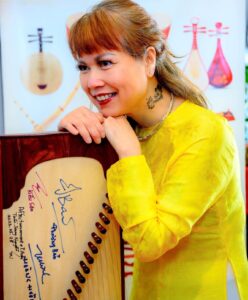
Phuong Anh Nguyen
Phuong Anh Nguyen discovered the đàn tranh at the age of seven and began classical training, which she continued until earning her diploma from the Conservatory in Vietnam at the age of eighteen.
Since then, she has never stopped deepening her mastery of this iconic instrument. Over the years, she has expanded her artistic journey through numerous performances and collaborations.
Deeply connected to the Vietnamese repertoire, Phuong Anh Nguyen also enjoys exploring contemporary works and arrangements, revealing the richness, sensitivity, and enduring relevance of the đàn tranh.
